

Guide: How to Choose your Size + Example
About this Guide
This page contains additional information about choosing your size for Stitchmaiden sewing patterns and provides an example for you to better understand the process of choosing sizes.
As sewing your handmade items is a passion project and an act of love, we want to help you to pick your size carefully, so you can sew a garment that fits your own unique body shape best and that you enjoy to wear for many seasons of your life!
General Stitchmaiden Sizing Information
The sewing patterns are drafted on the German Standard size range EU 34–46 and for a body height of 168 cm.
We also offer a selection of Plus Size patterns in EU sizes 46–58 and for a body height of 171 cm.
Each pattern pdf includes a size information page. Please always prioritize the information on this page. This page contains:
-
The size chart & detailed information on which measurements are relevant
-
Fit notes specific to the design
-
Information about the included ease
How to Measure Yourself
Measuring Tips
-
Use a flexible measuring tape
-
Keep the tape straight and parallel to the floor
-
Stand in a natural posture
-
Measure the fullest parts of your body
-
Wear undergarments similar to those you plan to wear with the finished garment, as they can influence your body shape
-
For the most accurate results, it is best to ask someone to help you measure
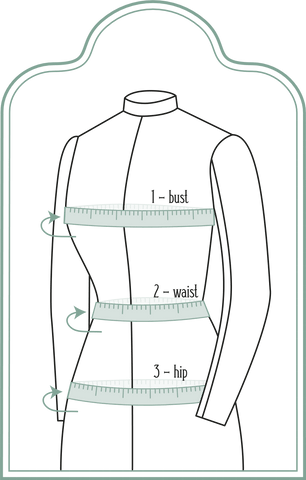
Where to Measure
To choose the correct size, you will need the following body measurements:
Bust
Measure around the fullest part of your bust.
Waist
Measure the narrowest part of your torso, or the point where your body naturally bends when you lean sideways. This is usually around the middle of your abdomen.
Hip
Measure the fullest part of your hips, typically around the seat. Depending on body shape, this point may sit slightly higher or lower.
How to Choose Your Size
Depending on the pattern, you need to prioritise a certain measurement more.
For example, when making a skirt you usually prioritise the waist measurement and the hip measurement, but you do not need a bust measurement.
Each pattern's sewing instructions will list the relevant measurements for that specific garment. As a general guideline:
-
Garments for the upper body (tops, blouses, vests, jackets, etc.) usually require bust and waist measurements.
-
Garments for the lower body (skirts and trousers) usually require waist and hip measurements.
-
Full-body garments (dresses, jumpsuits) may require all three measurements.
In some cases, certain measurements may not be relevant depending on the design.
For example, if a skirt is very flared, the hip measurement may not matter, and only the waist measurement determines the size.
Most of our patterns require two key measurements.
Step 1 – Determine Your Size for Each Measurement
Compare each of your measurements with the measurement chart provided with the pattern.
-
If your measurement falls between two sizes, choose the closest size.
-
If your measurement is exactly between two sizes, choose the smaller size.
Step 2 – Compare Your Measurements with the Pattern Ease
What is Ease?
Ease is the additional width included in a garment beyond the body measurements.
Ease serves two purposes:
-
Comfort and mobility – allowing the body to move naturally
-
Design and fit – controlling how loose or fitted a garment appears
For example:
-
Elastic undergarments (such as bras or panties) often have zero or negative ease so they fit like a second skin.
-
Woven garments, such as a linen blouse, require more ease because the fabric has no stretch and the garment is worn over undergarments.
Using Ease:
If your relevant measurements correspond to different sizes, you will need to check whether the smaller size will still fit once the pattern ease is included.
Ease is the additional width built into the garment to allow for comfort and movement.
Remember that garments always require some ease for comfort and mobility.
Check whether:
Your body measurement is the same or smaller Size chart measurement plus pattern ease:
-
If yes, you can choose the smaller size
-
If no, choose the larger size and adjust the pattern if necessary

Example
Let’s look at an example using the Bluebell Dress.
The Bluebell dress size is determined by bust and waist measurements.
The hip measurement is not relevant for this pattern.
Our fictional customer Alice has the following measurements:
-
Bust: 95 cm (37.4 inch)
-
Waist: 78 cm (30.7 inch)
-
Hip: 107 cm (42.1 inch)
Step 1 – Determine Alice’s Size For Each Measurement
Bust:
95 cm falls between size 40 (92 cm) and size 42 (96 cm), but it is closer to size 42, so her bust corresponds to size 42.
Waist:
78 cm falls exactly between size 40 (76 cm) and size 42 (80 cm).
When this happens, choose the smaller size, so her waist corresponds to size 40.
Hip:*
107 cm falls between size 42 (105 cm) and size 44 (109 cm), but it is closer to size 44.
So her hip size would be 44.
*Although the hip measurement is not needed for the Bluebell dress, determining all measurements can still help with overall fit analysis.
Step 2 – Check the Pattern Ease
The Bluebell Dress includes:
-
12 cm (4.72 in) ease at the bust
-
7 cm (2.76 in) ease at the waist
Alice’s relevant measurements suggest two sizes:
-
Bust: 42
-
Waist: 40
We now check if the smaller size (40) could still fit once the ease is included.
Bust measurement comparison:
95 cm < 104 cm (92 cm (Size 40) + 12 cm (Ease))
Since Alice’s bust measurement is smaller than the bust measurement of size 40 plus the ease, the smaller size will still fit.
Remaining ease:
104 cm − 95 cm = 9 cm ease remaining
This amount of ease still allows comfortable movement, so Alice can safely choose size 40.
As a general guideline, a garment should retain at least about two-thirds of the original ease for proper comfort and movement.
Recommendation: Sew a Test Muslin
We strongly recommend sewing a test garment (muslin) before cutting into your final fabric. This step helps ensure the best possible final result.
A test muslin allows you to:
-
Check the chosen size and fit
-
Make fitting adjustments specific to your body (for example full-bust-adjustment, shortening torso, widen biceps on sleeves & more)
-
Make fitting adjustments based on personal preference (for example lengthening skirt, widen necklines & more)
-
Practice unfamiliar sewing techniques